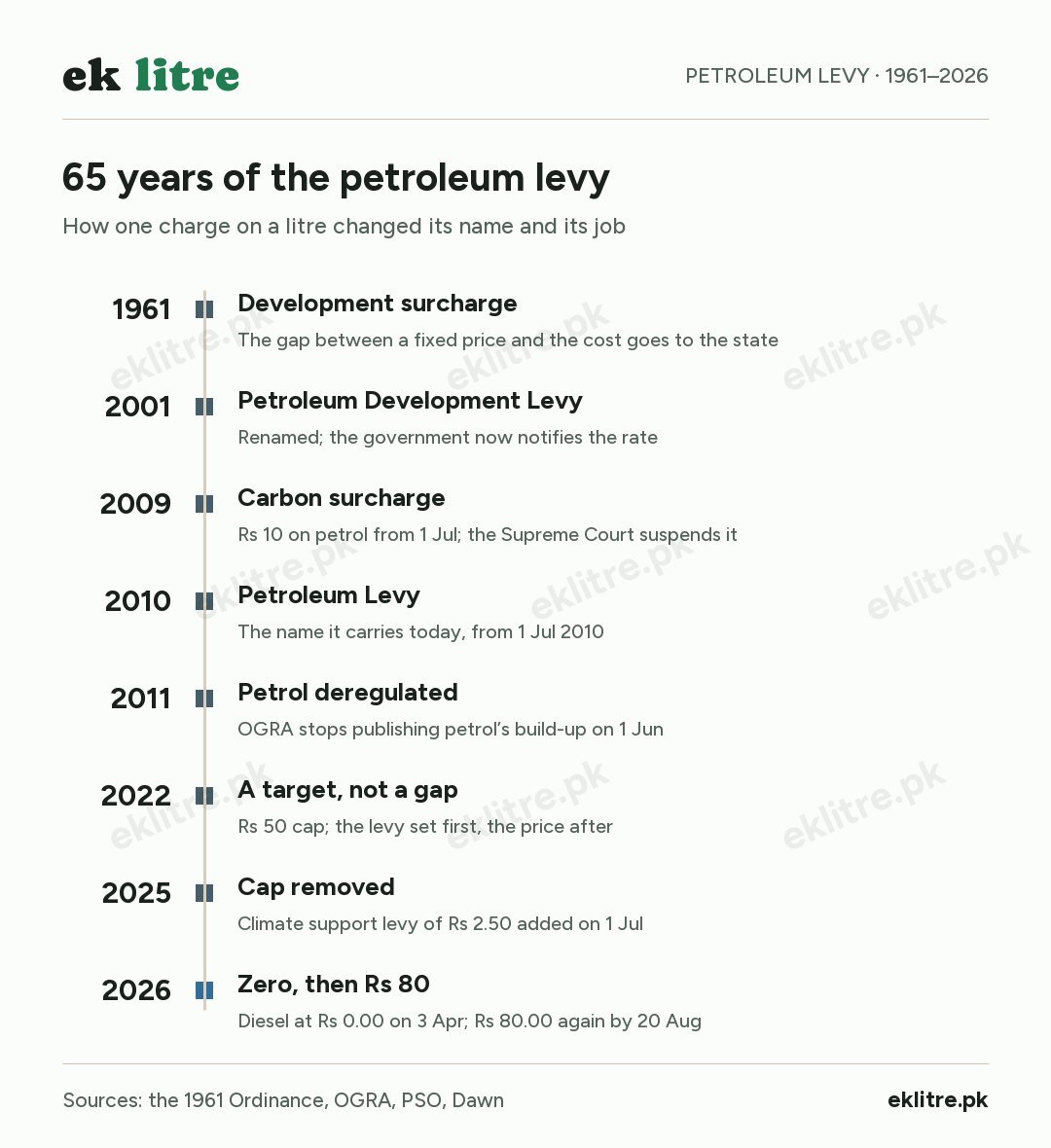
Did you know Pakistan’s petroleum levy is 65 years old? It started in 1961, when the government fixed the price of fuel.
The levy was the difference between that fixed price and the real cost of the fuel. The government kept this difference.
So when oil became expensive, the levy became smaller, and the pump price stayed the same. It worked like a car’s shock absorber.
Here is an example. Between February 2007 and January 2008, petrol’s levy fell from Rs 15.35 to Rs 0.00.
During all that time, the petrol price did not change. It stayed at Rs 53.70 a litre.
Today it works the other way. Since 2022, the government first decides the levy, and the price changes around it.
The levy is now Rs 80 a litre. In this article, I explain how it got here, step by step.
What is the petroleum levy?
Before a litre of petrol reaches your car, many people need to be paid.
Someone takes the crude oil out of the ground. Someone refines it, ships it to Karachi, and transports it across the country.
The oil company that sells it takes a margin. The petrol pump dealer also takes a margin.
Together, these make the cost of a litre. The price is what you pay at the pump.
The petroleum levy is a fixed amount in rupees that the government adds on top of the cost. The government keeps all of it.
Today the levy is Rs 80.00 a litre on both petrol and diesel, according to OGRA’s daily figures.
OGRA is the Oil and Gas Regulatory Authority. Every day, it publishes what each part of a litre’s price pays for.
When and how did the levy start?
The levy started on 1 July 1961, when Pakistan was under martial law. There was no parliament, so laws were made by ordinance.
The law was called the Petroleum Products (Development Surcharge) Ordinance, 1961. It applied from 1 August 1959, almost 2 years before it was signed.
The idea was simple. The government fixed the price of each fuel at its level on 31 July 1959.
The law called this the fixed sale price. It called the oil company’s allowed cost the prescribed price.
The difference between the 2 was called the differential margin. The law said companies must pay it to the government:
“every company shall pay to the Government a development surcharge equal to the differential margin”
In simple words: the price stayed at its 1959 level, the company got its cost, and the government got the rest.
Nobody chose the size of the levy. It was simply whatever was left between the price and the cost.
When oil became expensive, the cost went up. The price could not change, so the levy became smaller.
When oil became cheaper, the cost went down, and the levy became bigger.
At the pump, people saw no change at all. The levy moved instead of the price.
What was the levy meant to pay for?
The old name was development surcharge, so you might think it paid for development. The law does not say that.
The 1961 law does not reserve the money for anything. There is no fund, no list of projects, and no rule about roads or schools.
The government collects the money and spends it like any other income.
One small section of the law shows how the government saw it. Section 5 lets a company deduct the surcharge from its taxable income.
This means the government did not treat it as a tax on the company. It treated it as the government’s own share of the price.
So the honest answer is this: the levy was meant to keep the price steady and give the government the difference.
Why has the levy had different names?
The name changed each time the levy’s role changed a little.
In 2001 it became the Petroleum Development Levy. Now the government could set a fixed rate in rupees, instead of just collecting the difference.
In the 2009 budget, it was renamed the carbon surcharge. It was Rs 10 a litre on petrol from 1 July 2009.
It lasted about a week. The Supreme Court stopped the carbon tax and told OGRA to withdraw it.
OGRA’s own records show what happened that week.
The levy was Rs 10.00 on 1 July, Rs 0.00 on 8 July, and back to Rs 10.00 on 9 July.
From 1 July 2010, the law named it the Petroleum Levy. That is still its name today.
In 2025 a second charge was added under the same law. It is called the Climate Support Levy.
It started at Rs 2.50 a litre on 1 July 2025 and doubled to Rs 5.00 on 1 July 2026.
How did the levy keep prices steady in 2006–2008?
For most of its history, the levy was not published in detail. But from 2006 to 2011, it was.
Every 2 weeks, OGRA published petrol’s full price breakdown: oil, freight, margins, taxes and the levy. I have kept a copy.
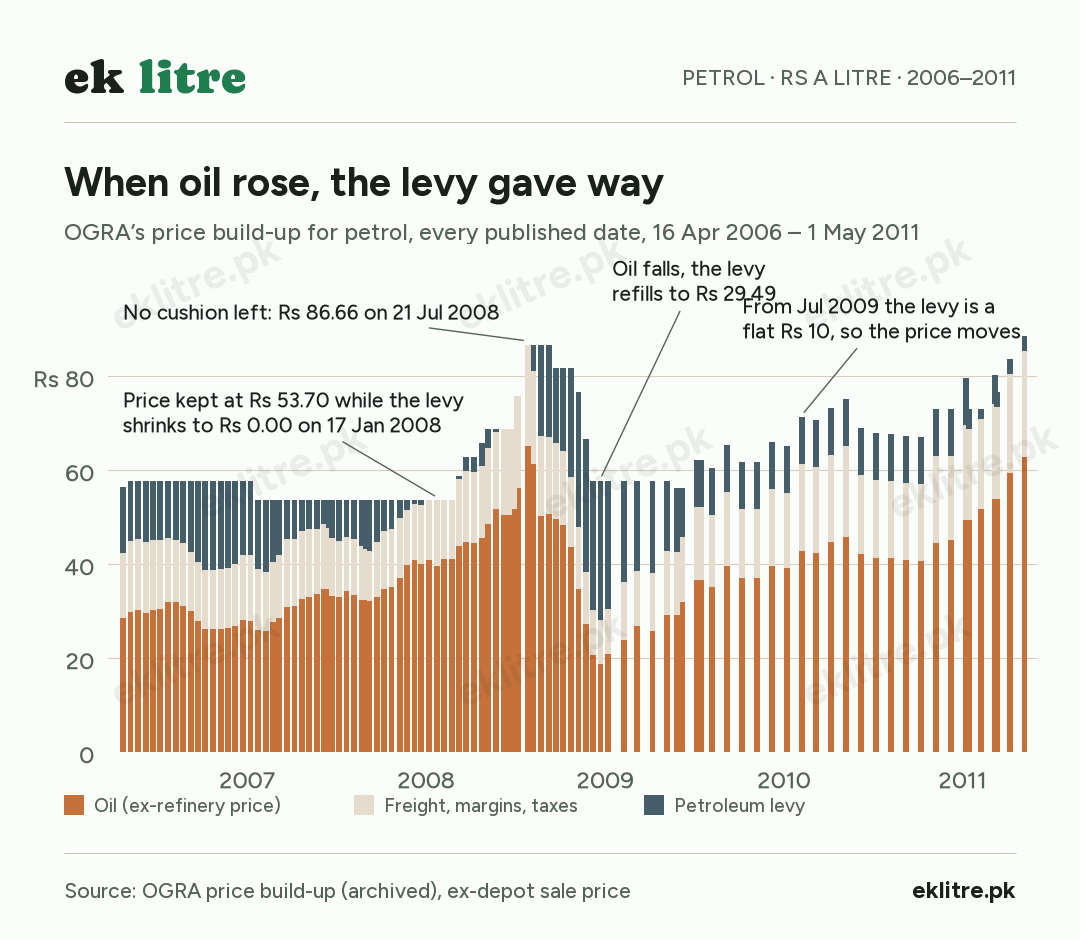
Look at 2006 on the left. The price stayed at Rs 57.70 for 17 updates in a row.
The cost of oil kept changing, from Rs 26.13 to Rs 31.90. The levy moved the opposite way, so the total stayed the same.
On 16 January 2007, the price was cut to Rs 53.70. It stayed there for more than a year.
In that time, the cost of oil rose from Rs 25.97 to Rs 41.16 a litre. The levy became smaller to make room for it.
The levy fell step by step: Rs 14.85, then Rs 8.40, then Rs 3.95, then Rs 0.99 in December.
On 17 January 2008, it reached Rs 0.00.
So for a whole year, oil prices rose by more than half, but petrol in Pakistan did not cost a rupee more.
The government paid for this by giving up the levy.
What happened when the levy reached zero in 2008?
Once the levy was zero, there was nothing left to protect the price. Oil kept rising.
So every increase in oil now went straight into the price. It went up in March, April and May 2008.
By 21 July 2008, petrol cost Rs 86.66 a litre. 5 months earlier, it was Rs 53.70.
Then oil prices crashed. The cost of oil in a litre fell from Rs 65.11 in July to Rs 18.81 in December.
This time the levy worked for the government. The price only fell to Rs 57.66.
The rest of the fall went into the levy. It grew to Rs 29.49, its highest level in those 5 years.
So the levy worked both ways. When oil was costly, the government earned less; when oil was cheap, it earned more.
And when oil was cheap, people did not get the full price cut.
Why did the levy stop changing with oil prices?
Look at the right side of the chart. From July 2009, the levy was always Rs 10.00.
This was the change made with the carbon surcharge. The levy became a fixed amount, so the price now moved with oil.
In 2009 and 2010, the price went up and down: Rs 60.46, Rs 65.26, Rs 61.63, Rs 71.21.
The government still cut the levy sometimes. In early 2011, it lowered it from Rs 10.00 to Rs 4.27, then Rs 2.20.
But now each cut was a decision. The levy no longer moved on its own.
On 1 June 2011, OGRA stopped publishing petrol’s price breakdown.
For the next 15 years, only the pump prices are on record. The rest comes from budgets and news reports.
In the late 2010s, the government changed sales tax as often as the levy.
In 2021 and early 2022, both were cut to almost zero to keep prices down.
Then, under the IMF programme agreed in 2022, the levy came back as a fixed target.
Parliament had set a maximum levy of Rs 30 a litre in 2018. This limit rose to Rs 50 in 2022.
It rose again to Rs 70 in 2024. In 2025, the limit was removed.
Now the government decides the levy first. The price is built on top of it.
Has the government cut the levy to protect prices since then?
Yes, twice in the last 2 years. Both times, it was a government decision, not automatic.
The first time was April 2025, and it worked in the government’s favour.
Oil prices had fallen, and OGRA had worked out a price cut of up to Rs 13 a litre.
But the government kept the price the same and raised the levy instead.
It said the money would pay for Rs 1.71 of a Rs 7.41 cut in electricity prices per unit.
On 16 April 2025, PSO’s notice shows diesel’s levy at Rs 77.01. The price stayed at Rs 258.64, the same as 2 weeks before.
The second time was April 2026, and this time it protected the public.
The war with Iran made oil very expensive. On 3 April 2026, petrol rose by Rs 137.23 to Rs 458.41, Dawn reported.
Diesel rose by Rs 184.49 to Rs 520.35 a litre.
Diesel runs trucks, buses and tractors, so the government protected it. It cut diesel’s levy from Rs 55 to zero.
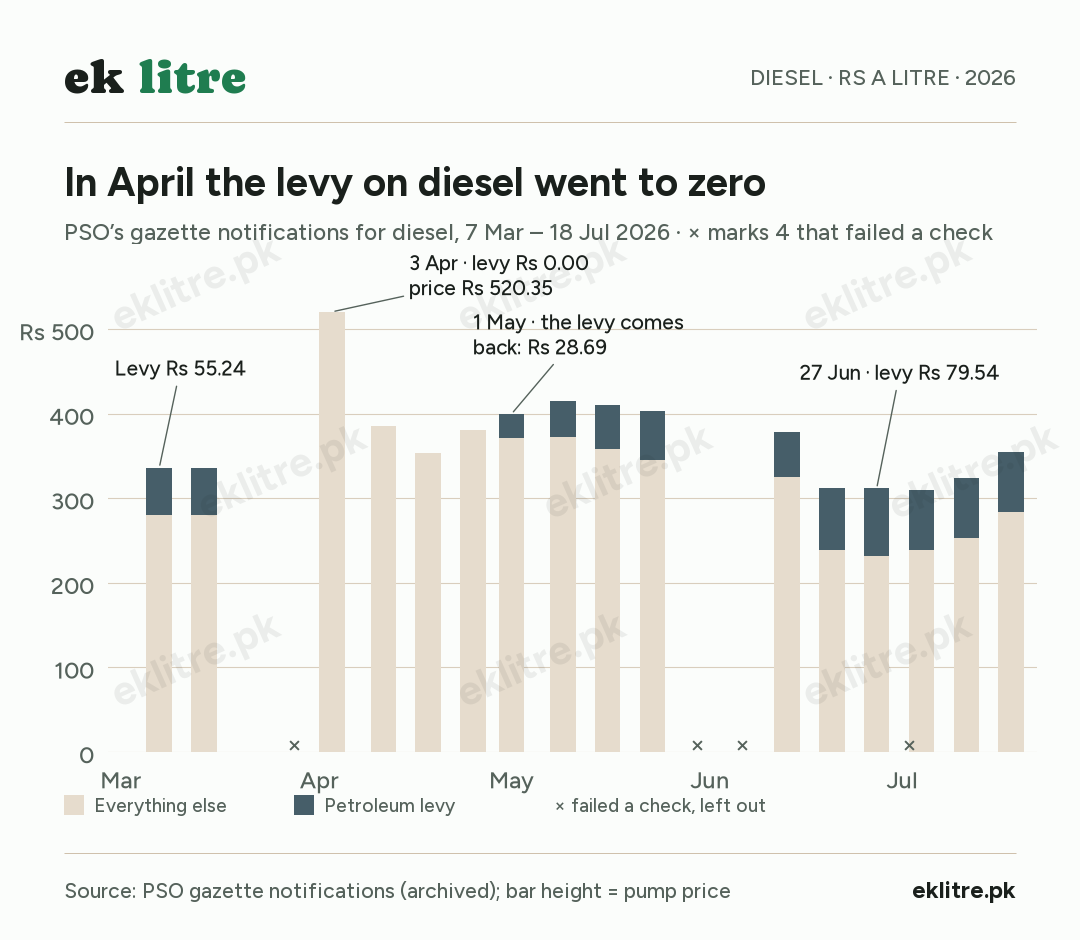
PSO, or Pakistan State Oil, publishes diesel’s price in the official gazette. Its notices show the levy at Rs 55.24 in early March.
On 3 April, the levy was Rs 0.00. It stayed at zero on 11, 18 and 25 April.
For 4 weeks, the levy worked like it did in 2008. It took as much of the price rise as it could.
Petrol was treated differently. On the same day, petrol’s levy went up from Rs 105 to Rs 160 to cover diesel.
This meant car owners were paying part of the cost of cheaper diesel.
This lasted only 1 night. On 4 April, the Prime Minister cut petrol’s levy by Rs 80, and petrol fell to Rs 378.41.
After that, the government rebuilt diesel’s levy step by step, whatever oil prices did.
It was Rs 28.69 on 1 May, then Rs 42.60, Rs 52.00 and Rs 58.00 later that month.
It was Rs 72.97 on 20 June and Rs 79.54 on 27 June.
My own daily record starts on 21 July, at Rs 70.82. The levy reached Rs 80.00 on 20 August and has stayed there.
So the levy can still protect prices. In 1961 oil prices decided when that happened, but today the government decides.
How much money does the levy collect now?
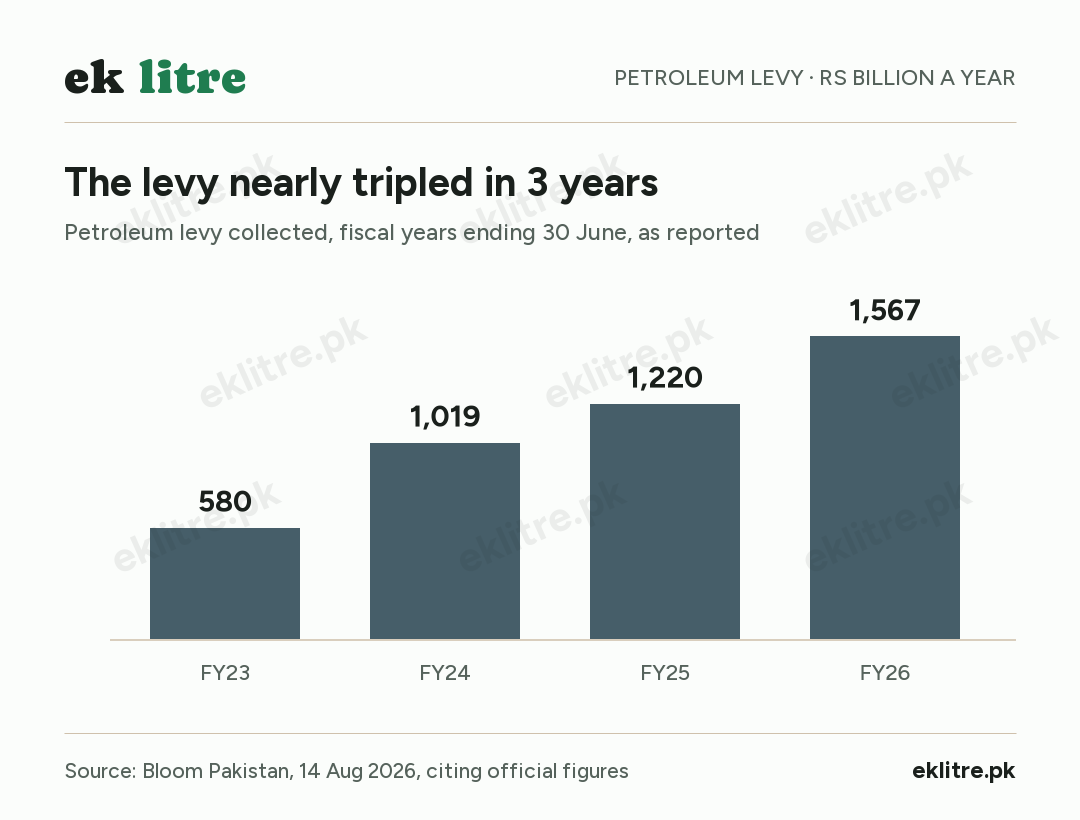
In the year to June 2026, the levy collected Rs 1,567 billion, Bloom Pakistan reported on 14 August 2026.
That was about Rs 100 billion more than the budget expected. 3 years earlier, it collected Rs 580 billion.
Like in 1961, this money is not reserved for anything specific.
In April 2025, the government said a levy increase would help cut electricity bills. That is the only recent use it named.
Otherwise, the money goes into the federal budget. It pays for things like debt, defence, salaries and subsidies.
The levy is now a big part of the government’s income.
According to the Pakistan Institute of Development Economics, petroleum taxes grew from 15% of all tax income in 2005–06 to 35% in 2018–19.
And that was before the levy’s biggest increases began.
How is the levy different from other taxes on fuel?
A litre of petrol has 4 government charges: the petroleum levy, the climate support levy, customs duty and sales tax.
The climate support levy, Rs 5.00, works the same way as the petroleum levy. So the table compares the other 3.
| Petroleum levy | Customs duty | Sales tax | |
|---|---|---|---|
| How it is set | Rupees a litre | A share of the import value | A share of the price |
| Moves with oil? | No, unless changed | Yes | Yes |
| On 25 Sep 2026, petrol | Rs 80.00 | Rs 23.68 | Rs 0.00 |
| In the budget | Non-tax revenue | Tax revenue | Tax revenue |
| Shared with provinces? | No | Yes | Yes |
| Law | 1961 Ordinance | Customs Act, 1969 | Sales Tax Act, 1990 |
There are 2 big differences. The first is how each charge is calculated.
Customs duty and sales tax are percentages. When oil prices rise, they rise too, which makes price jumps bigger.
The levy is a fixed amount in rupees. It stays at Rs 80 until the government changes it.
The second difference is who keeps the money.
Sales tax and customs duty are shared with the 4 provinces, through the National Finance Commission (NFC) award.
The petroleum levy is not shared. It counts as non-tax income, so the federal government keeps every rupee.
This is why the levy has grown while sales tax on fuel has fallen to zero.
Business Recorder estimated that the provinces lost about Rs 500 billion this way in 2023–24.
Which figures in this article can be checked?
You can check every number in this article. Each dated figure comes from a published document that I have saved.
They come from 3 main sources:
- Petrol, 2006–2011: OGRA’s price breakdown, published every 2 weeks. See how I recovered it.
- Diesel, 2025–2026: PSO’s official gazette notices, which I found while writing this article.
- Both, from 21 July 2026: OGRA’s daily price breakdown, in this record.
PSO lists 336 diesel notices, going back to July 2008. Only 68 can be read as text; the rest are scanned photos.
I do not use any figure from the scanned photos.
42 of the 68 notices pass 3 checks. Only those are shown in the chart.
The checks are: the numbers add up, the levy matches the direct-sale row, and the price matches PSO’s published pump price.
From June 2011 to July 2026, petrol has only prices on record, with no breakdown.
Petrol’s levy in those years, like Rs 105 in March 2026, comes from news reports. I say so each time.
That is why no petrol figure from those 15 years appears in any chart.
Common questions
When did the petroleum levy start in Pakistan?
It started in 1961, applying from 1 August 1959. It got its current name, the Petroleum Levy, on 1 July 2010.
What was the petroleum levy for?
It was the difference between a fixed fuel price and the real cost. The law did not reserve the money for any purpose.
Is the petroleum levy a tax?
Not officially. It counts as non-tax income, so the federal government keeps all of it and does not share it with provinces.
Has the petroleum levy ever been zero?
Yes. Petrol’s levy was Rs 0.00 in January 2008, and diesel’s was Rs 0.00 in April 2026, in official records.
How much money does the petroleum levy collect?
Rs 1,567 billion in the year to June 2026, as reported by Bloom Pakistan. That is up from Rs 580 billion 3 years earlier.
Sources
- The 1961 wording and datesThe Development Surcharge Ordinance, 1961, from the Petroleum DivisionPrimary · SHA-256 archived
- The law as it stands todayThe Petroleum Levy and Climate Support Levy Ordinance, from Pakistan CodePrimary · SHA-256 archived
- Petrol, 2006–2011OGRA’s fortnightly price build-up, as recovered herePrimary · SHA-256 archived
- Diesel, 2025–2026PSO’s gazette notifications for high-speed dieselPrimary · SHA-256 archived
- Petrol and diesel from 21 July 2026OGRA’s daily price build-up, as this record holds itPrimary · SHA-256 archived
- The 2009 carbon surcharge rulingDawn report on the Supreme Court’s 2009 rulingPress
- The April 2025 electricity reliefDawn report on the April 2025 power-tariff cutPress
- The 3 April 2026 price riseDawn report on the 3 April 2026 fuel price risePress
- Petrol’s Rs 80 levy cut, 4 April 2026Profit report on the 4 April 2026 levy cutPress
- Levy collections, FY23–FY26Bloom Pakistan report on FY26 levy collectionsPress
- The provinces’ loss, 2023–24Business Recorder estimate, as reportedPress
- Petroleum taxes’ share of revenuePIDE, Petroleum Pricing in PakistanAnalysis · SHA-256 archived
OGRA’s ex-depot price (source 3) and the pump price agree on most dates, not all. The historical build-up shows where they differ.