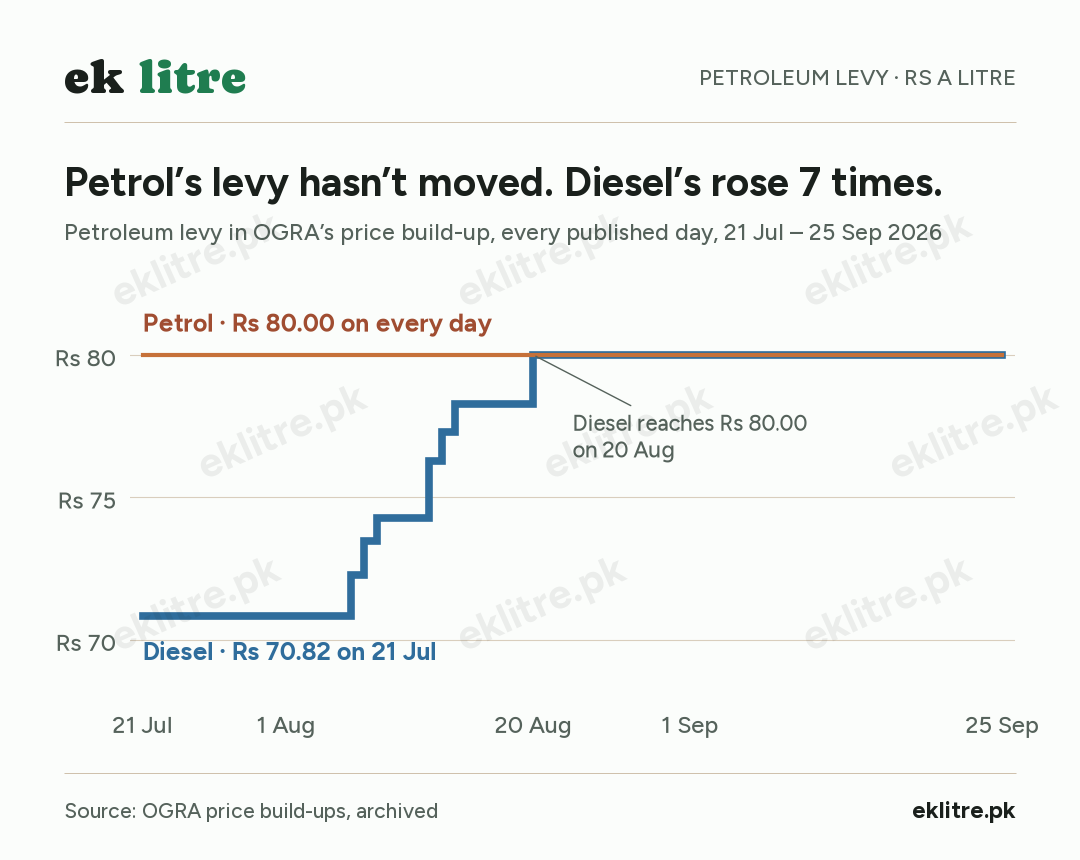
The petroleum levy is not why petrol costs more. Between 21 July and 25 September 2026, petrol went up Rs 73.48 a litre. The levy on it stayed at Rs 80.00 on every one of those days. Most of the rise — Rs 62.08 — was cost and freight: the world price of the fuel and shipping it to Karachi.
Diesel is a different story, but only in part. Its levy went up 7 times in August, from Rs 70.82 to Rs 80.00. That added Rs 9.18 a litre: about 1 rupee in every 6 of diesel’s Rs 52.06 rise.
This matters because the levy is now at the centre of a political fight. Jamaat-e-Islami has protested against it since mid-August. On 3 September, the day of a nationwide strike, the government agreed to set up expert teams with the party to look at cutting it. The party’s proposal, reported on 12 September, asks for a levy of Rs 5 to 10 a litre instead of Rs 80.
The fight rests on a simple idea: fuel is dear because the government taxes it. For diesel, that is partly true. For petrol, the official figures say otherwise. And some of the numbers going round are out of date, or don’t match anything that was published — a Rs 77.28 diesel levy that had already been replaced, and a Rs 114 petrol tax total that is Rs 8.04 more than that day’s tax lines add up to.
The way to settle it is to read the levy the way it is published. OGRA, the Oil and Gas Regulatory Authority, puts out a price build-up — a list of what each rupee of a litre pays for. Every figure below comes from those lists, as this record holds them, day by day.
What raised the petrol price?
The world price of fuel, by a wide margin. The table splits petrol’s Rs 73.48 rise into the lines OGRA prints. The levy’s line reads zero.
| Petrol, 21 Jul → 25 Sep 2026 | Change (Rs) |
|---|---|
| Cost and freight | +62.08 |
| Customs duty | +6.40 |
| Exchange-rate adjustment | +2.43 |
| Dealer commission | +1.34 |
| Inland freight equalisation (IFEM) | +0.76 |
| Ocean loss or gain | +0.48 |
| Incidentals | −0.01 |
| Petroleum levy | 0.00 |
| Price at the pump | +73.48 |
OGRA prints cost and freight as one rupee figure. Behind it is the Platts world price of petrol: US$97.99 a barrel on 21 July and US$130.73 on 25 September. The rupee barely moved, from Rs 278.14 to the dollar to Rs 277.37.
Each line is the change between two figures OGRA printed, and together they add up to Rs 73.48. The Rs 1.34 in the dealer margin is the raise the government approved for petrol pumps in August, from Rs 8.64 to Rs 9.98 a litre.
So the government’s share of the rise was small. Its 4 tax lines on petrol went up Rs 6.40 in all — every rupee of it customs duty — which is less than 9% of the increase.
Diesel needs a warning. OGRA changed the layout of diesel’s price on 20 August, so most of its lines before and after that date don’t compare one for one. The levy line is the exception: it means the same thing on both sides, which is why its Rs 9.18 rise can be stated plainly. The note on the diesel change explains the rest.
How much of a litre goes to the government?
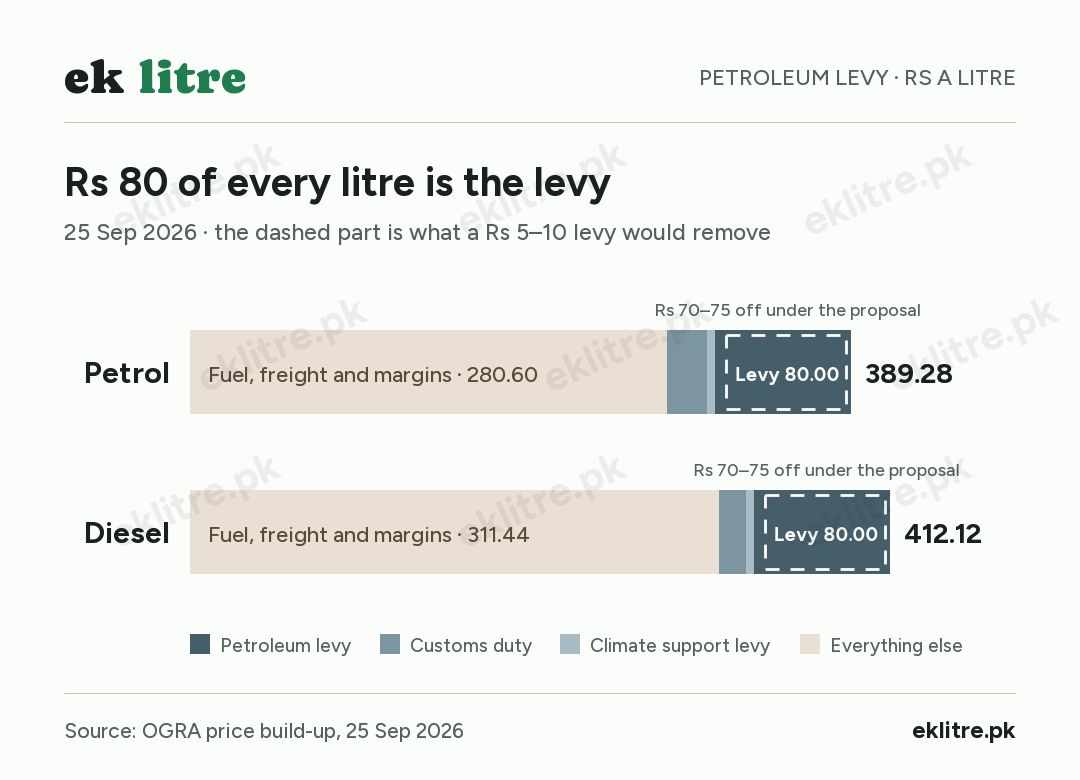
On 25 September 2026, Rs 108.68 of petrol’s Rs 389.28 went to the government — 27.9% of the price. On diesel it was Rs 100.68 of Rs 412.12, or 24.4%. OGRA lists it in 4 lines.
| Tax line, 25 Sep 2026 | Petrol (Rs) | Diesel (Rs) |
|---|---|---|
| Petroleum levy | 80.00 | 80.00 |
| Customs duty | 23.68 | 15.68 |
| Climate support levy | 5.00 | 5.00 |
| Sales tax | 0.00 | 0.00 |
| Total to the government | 108.68 | 100.68 |
| Share of the price | 27.9% | 24.4% |
The levy is by far the biggest of the 4. 2 of the others never changed: the climate support levy was Rs 5.00 on both fuels every day, and sales tax was listed as zero every day. Customs duty is the one that moves. On petrol it went from Rs 17.28 to Rs 23.68 over the period; on diesel it stayed at Rs 15.68. The state’s share of a litre explains what each tax is for.
There is a twist in the percentages. Because the levy is a fixed number of rupees, it becomes a smaller share of the price as fuel gets dearer. On 21 July the tax lines were 32.4% of petrol’s price. By 25 September they were 27.9%. The levy didn’t go down. The price grew around it.
These 4 lines are also the quickest way to check the numbers in the debate. News reports on 3 September put the government’s take at Rs 114 a litre on petrol and Rs 100 on diesel, with a diesel levy of Rs 77.28. OGRA’s figures for that day show Rs 105.96 on petrol and Rs 100.68 on diesel. The diesel total matches. The Rs 77.28 was diesel’s levy on 13 August — by 3 September it had been Rs 80.00 for 2 weeks. The petrol figure is Rs 8.04 more than the day’s tax lines contain, and OGRA’s figures don’t show what the difference is.
What would a Rs 5–10 levy do to the price?
On paper, it would take about Rs 70–75 off every litre. Take OGRA’s figures for 25 September 2026, keep every other line as it is, and swap Rs 80 for Rs 10 or Rs 5. Sales tax is zero, so no tax sits on top of the levy that would fall with it.
| Petrol (Rs) | Diesel (Rs) | |
|---|---|---|
| Price on 25 Sep 2026 | 389.28 | 412.12 |
| With a Rs 10 levy | 319.28 | 342.12 |
| With a Rs 5 levy | 314.28 | 337.12 |
That is roughly the whole of petrol’s rise since July. But it is a sum, not a forecast. Prices now change almost every day; the other lines move with oil prices, shipping costs and the rupee; and whether a lower levy would reach the pump in full is for the government to decide.
The cost is the other half of the argument. According to figures reported with the proposal, the levy brought in Rs 1,557 billion in 2025–26, more than its Rs 1,468 billion target, and is expected to bring in Rs 1,576 billion in 2026–27. The party estimates a Rs 5–10 levy would leave a gap of Rs 1.45–1.5 trillion a year. It suggests filling it with higher taxes on luxury goods, a surcharge on the biggest companies and highest earners, fewer tax breaks and lower interest costs. Those are the party’s estimates; OGRA’s figures can’t test them.
Is the levy an IMF condition?
Partly — and the government has said both things. When it launched the Rs 100 petrol relief on 13 September, the Finance Ministry refused to cut the levy instead, pointing to the terms of the IMF programme; the note on the relief covers that scheme, which leaves the levy untouched. On 22 September the ministry called the levy “not the central element” of the programme — one way of raising money among several — while still counting petrol pricing and levy measures as part of the agreed plan.
Neither statement names a levy rate the IMF requires. OGRA’s figures show what the rate has been. They can’t show what it has to be.
Common questions
How much is the petroleum levy in Pakistan?
Rs 80.00 a litre on both petrol and diesel, in OGRA’s figures for 25 September 2026. Petrol’s levy has been Rs 80.00 on every published day since 21 July 2026. Diesel’s went up 7 times in August, from Rs 70.82 to Rs 80.00.
How much tax is in a litre of petrol?
Rs 108.68 of Rs 389.28 on 25 September 2026, or 27.9%. That is the Rs 80.00 petroleum levy, Rs 23.68 customs duty and the Rs 5.00 climate support levy. Sales tax is listed as zero.
Did the petroleum levy cause the price rise?
Not for petrol. Its levy stayed at Rs 80.00 while the price went up Rs 73.48 between 21 July and 25 September 2026. Rs 62.08 of that rise was cost and freight. For diesel, the levy went up Rs 9.18 in August, from Rs 70.82 to Rs 80.00, while the price rose Rs 52.06.
What would a Rs 5–10 levy do to the price?
On OGRA’s figures for 25 September 2026, with nothing else changed, petrol would be Rs 314.28–319.28 and diesel Rs 337.12–342.12. That is a sum on a single day’s figures, not a forecast.
Is the petroleum levy an IMF condition?
Levy measures are part of the IMF programme, and the Finance Ministry pointed to it when it refused a cut in September. On 22 September it said the levy is not the programme’s central element. Neither statement names a rate the IMF requires.
Where these figures come from. Every price and line here is this record’s reading of OGRA’s published price build-ups — document 14672 for 21 July, 15453 for 20 August and 16634 for 25 September 2026 — each saved and traced to its source. How this record is read sets out the rules, and the history lists every change. The protests and talks are from Arab News; the proposal and the revenue figures from Daily Pakistan; the Finance Ministry’s 22 September statement from ProPakistani; the September refusal to cut the levy from Business Recorder. This note explains the dispute and takes no side in it.