No. On the petrol sheet of the Oil and Gas Regulatory Authority (OGRA), the petroleum levy is still Rs 80.00 a litre.
What changed on 31 October 2026 is who pays part of it. Refineries began to hand over Rs 14.71 of every litre’s levy.
That is why the pump price stayed at Rs 377.91, the same as on 30 October.
Many news reports called this a Rs 15 cut. The sheet shows a Rs 14.71 rise in costs that did not reach the pump.
On 12 November 2026 that part rose to Rs 16.36. The words on the sheet did not change.
Which rows did OGRA add to the petrol sheet?
OGRA prints a price sheet for each day, with a letter on every row.
On 31 October, petrol’s sheet grew from 20 rows, A to T, to 22, A to V. Both new rows are about the levy.
Here are the 3 levy rows as OGRA printed them.
| Row on the 31 October petrol sheet | Rs a litre | What the sheet says it is |
|---|---|---|
| Q, Petroleum Levy (PL) | 80.00 | Notified by the federal government |
| R, Petroleum Levy (PL) through Refineries | −14.71 | Paid by refineries on their sales to oil companies |
| S, Petroleum Levy (PL) direct, S = Q + R | 65.29 | Charged to oil companies |
Oil companies are the firms that buy fuel and sell it to pumps, such as Pakistan State Oil (PSO).
The total now adds row S, not row Q. Its printed formula is V = P + S + T + U.
So the levy in the total is Rs 65.29. The levy the government notified is still Rs 80.00.
Why did the pump price not change on 31 October?
Compare the sheets for 30 and 31 October. Several rows before the levy went up.
| Petrol sheet row | 30 October | 31 October | Change |
|---|---|---|---|
| B, premium including freight (US$ a barrel) | 19.88 | 25.52 | +5.64 |
| F, cost and freight (Rs a litre) | 245.90 | 254.46 | +8.56 |
| K, customs duty (Rs a litre) | 20.56 | 26.15 | +5.59 |
| L, ex-refinery or import price (Rs a litre) | 267.13 | 282.26 | +15.13 |
| P, price before levies (Rs a litre) | 292.91 | 307.62 | +14.71 |
| Levy in the total (Q, then S) | 80.00 | 65.29 | −14.71 |
| Climate support levy (R, then T) | 5.00 | 5.00 | 0.00 |
| Pump price (T, then V) | 377.91 | 377.91 | 0.00 |
Row P, the price before any levy, rose by exactly Rs 14.71. The new row R took off exactly Rs 14.71.
The 2 cancel out, so the pump price did not move. Some letters moved too: the total was row T, and is now V.
The premium is what Pakistan pays above the world price to bring petrol here. The premium note explains why it has risen.
The sheet does not split the Rs 14.71 between rows B, F, K and the rest, so I do not either.
How much do refineries pay on each litre?
Row R’s description gives 2 figures. Rs 14.71 is spread over “estimated total country volume”, meaning all petrol sold in Pakistan.
The sheet says it “shall be surrendered by Refineries @ Rs. 49.02/ltr on their sales to OMCs”. OMCs are the oil companies.
In plain words, a refinery hands over Rs 49.02 on each litre it sells. That covers Rs 14.71 on every litre in the country.
The 2 figures differ because refineries make only part of Pakistan’s petrol. ProPakistani reports they supply about 30%.
Why did the government ask refineries to pay?
OGRA’s sheet does not say. The reasons below come from the Petroleum Minister and the press, not from the sheet.
The Express Tribune reports that refineries now get a price fixed at the premium, incidentals and customs duty of 7 March 2026.
The paper calls that date “pre-war”. Imported petrol, by contrast, is priced at what Pakistan State Oil’s cargo actually cost.
Dawn reports a pre-war premium of US$5 to US$6 a barrel. It says the premium is now above US$20.
Petroleum Minister Ali Pervez Malik told Dawn that refineries “earned more profit in the last three months than in a year”.
He put the cost to refineries at about Rs 15 billion for one month, the Express Tribune reports.
How long will refineries pay part of the levy?
Dawn and the Express Tribune both report 30 days. Neither gives an end date.
OGRA’s sheet prints no end date either. When I wrote this note, row R was −Rs 14.71 on all 3 petrol sheets.
Those were the sheets for 31 October, 3 November and 4 November. Row R held at −Rs 14.71 until 11 November.
It changed on the sheet for 12 November. The row is still there, and no end date is printed.
The Petroleum Division’s levy notification gives no end date either. It is in force from 12 November 2026 “till further order”.
Row R was still −Rs 16.36 on the sheets for 13, 14 and 17 November.
What changed on 12 November 2026?
Row R went from −Rs 14.71 to −Rs 16.36 a litre. Row S, the levy charged to oil companies, fell by the same amount.
Here are the same 3 levy rows, before and after.
| Petrol sheet row | 31 October to 11 November | 12 and 13 November |
|---|---|---|
| Q, Petroleum Levy (PL) | 80.00 | 80.00 |
| R, Petroleum Levy (PL) through Refineries | −14.71 | −16.36 |
| S, Petroleum Levy (PL) direct | 65.29 | 63.64 |
So oil companies are charged Rs 63.64 of the levy, Rs 1.65 less than before. The notified levy is still Rs 80.00.
The words beside row R did not change. They still say “Rs. 14.71/ltr”, surrendered “@ Rs. 49.02/ltr”.
So the figure says Rs 16.36 and the description says Rs 14.71. The sheet does not say what refineries now hand over.
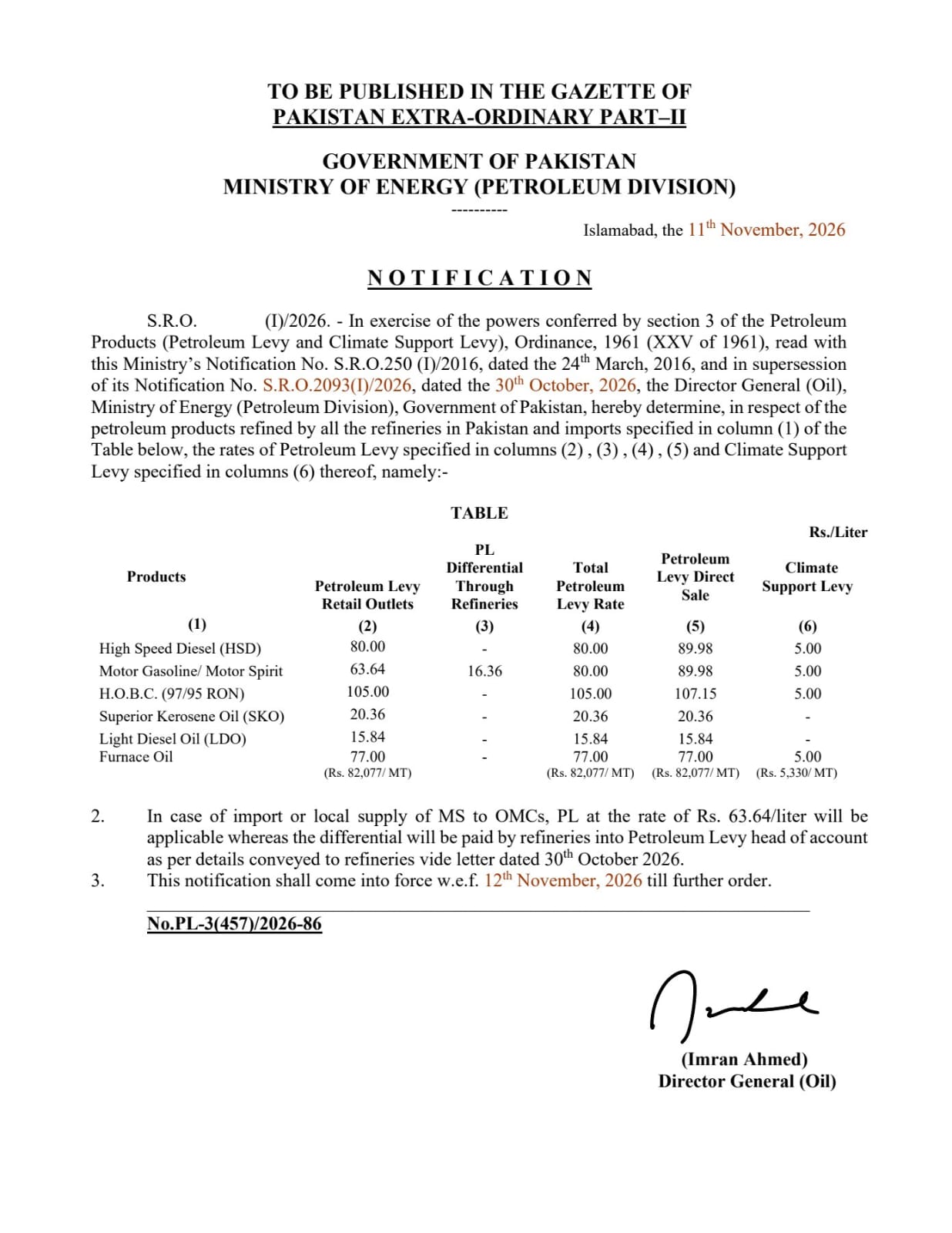
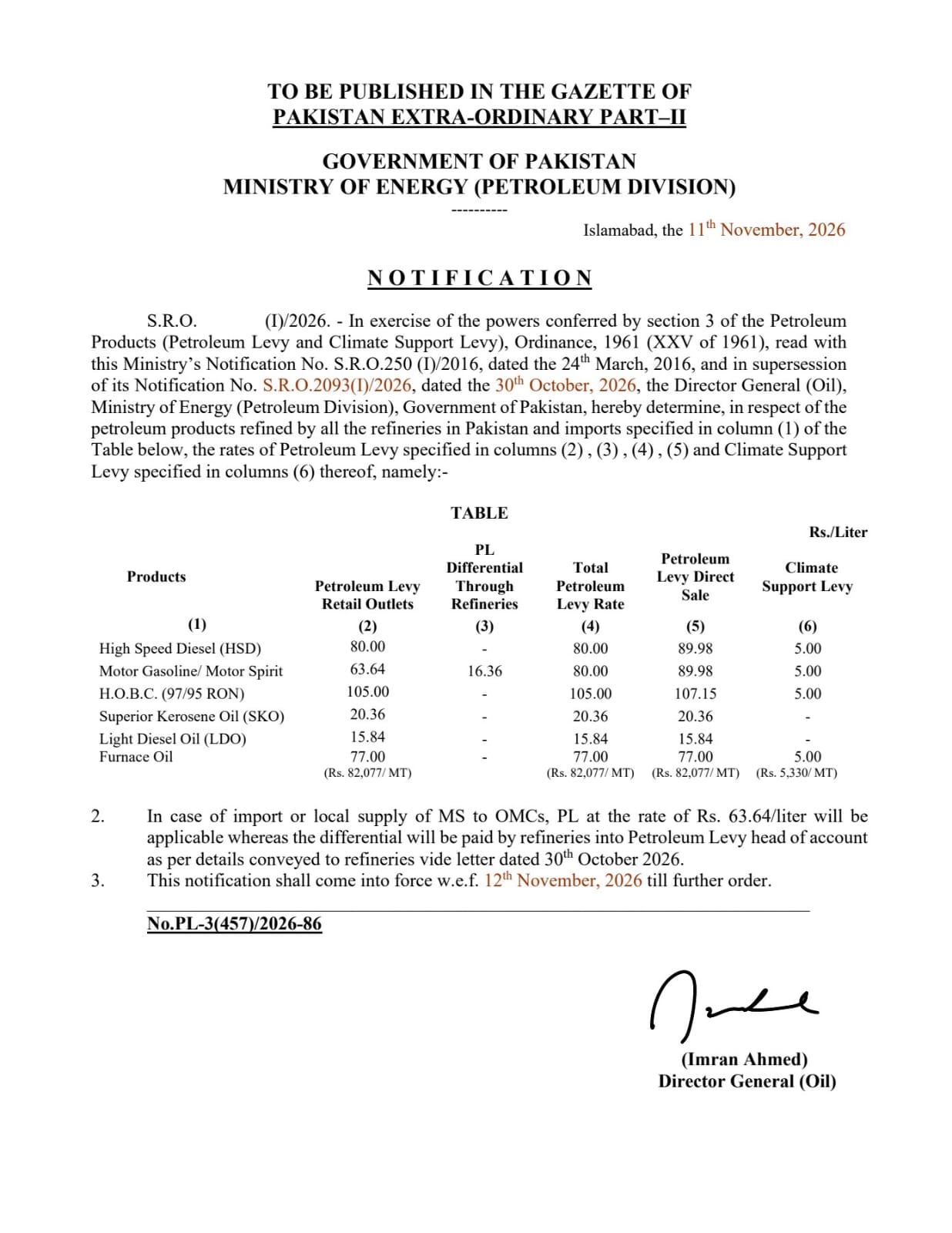
The Petroleum Division’s own levy notification prints the new figure. It is dated 11 November 2026 and in force from 12 November.
For petrol it prints Rs 63.64 a litre at retail outlets and Rs 16.36 as “PL Differential Through Refineries”. The total is Rs 80.00.
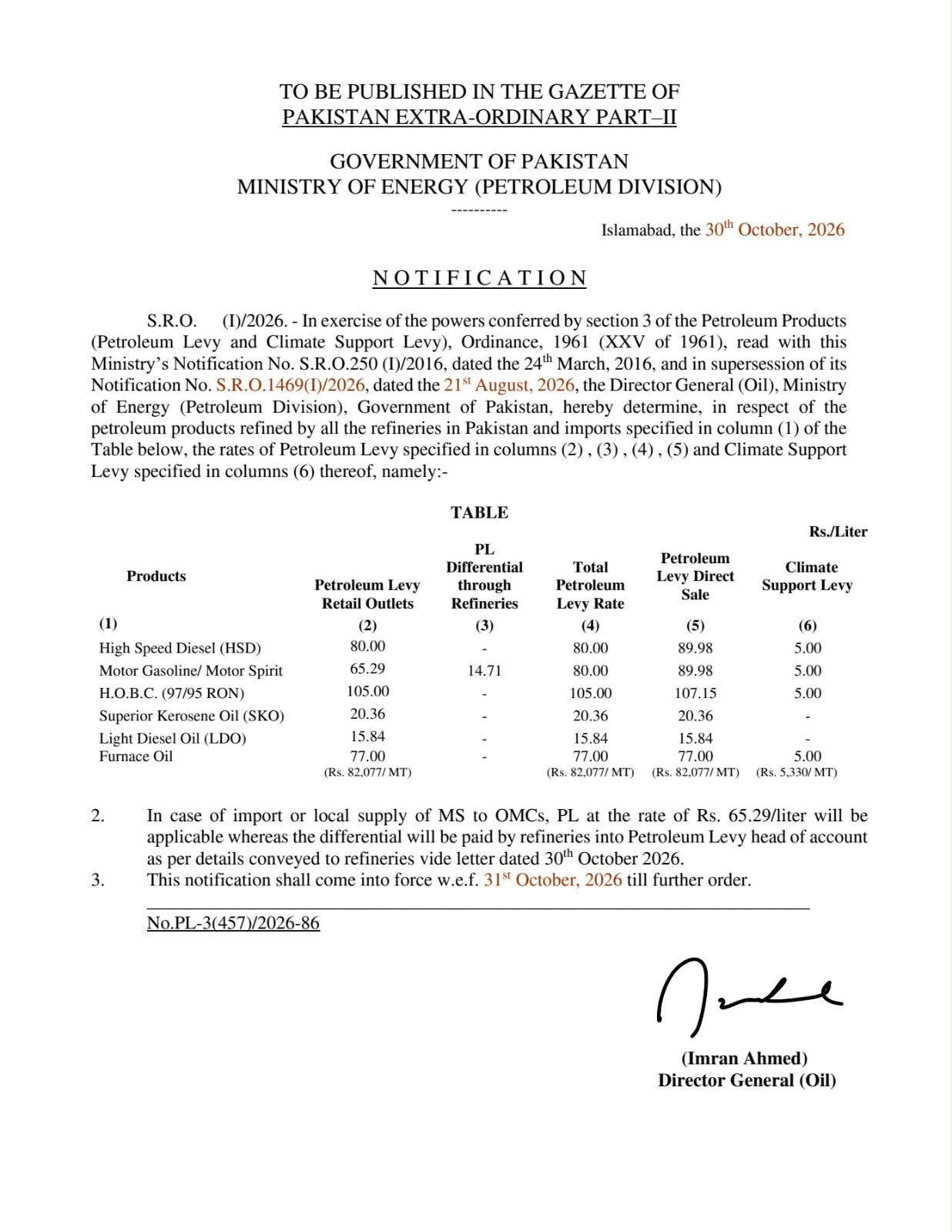
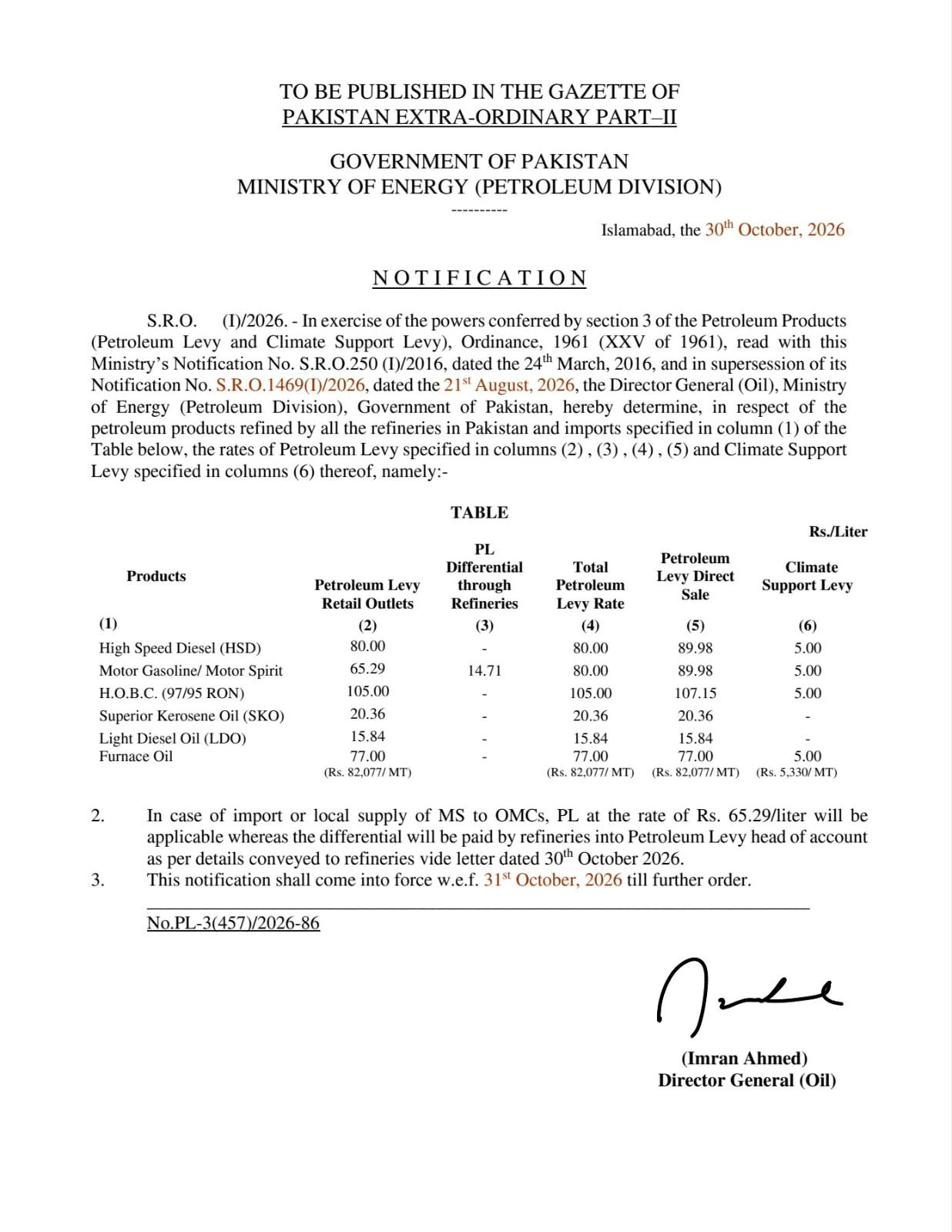
The notification before it, dated 30 October 2026, printed Rs 65.29 and Rs 14.71. So both pairs match OGRA’s rows.
Both notifications are images, so I read these figures by eye. Neither prints a rate on refineries’ own sales.
Each says refineries pay the difference “as per details conveyed to refineries vide letter dated 30th October 2026”. I have not seen that letter.
One other row moved on the same sheet. Row B, the premium, rose from US$25.67 to US$28.76 a barrel.
The sheet does not link the 2 rows, so I do not either.
How much of a litre goes to the government now?
I count customs duty, the levies and sales tax as the government’s part of a litre. All 4 are printed rows.
| Petrol sheet | Government’s part (Rs a litre) | Pump price (Rs a litre) | Share of the price |
|---|---|---|---|
| 30 October 2026 | 105.56 | 377.91 | 27.93% |
| 31 October 2026 | 96.44 | 377.91 | 25.52% |
| 4 November 2026 | 96.44 | 369.06 | 26.13% |
| 12 November 2026 | 94.58 | 335.00 | 28.23% |
From 30 to 31 October, the government’s part fell Rs 9.12. Customs duty rose Rs 5.59, and the levy in the total fell Rs 14.71.
On 4 November the government’s part was the same, Rs 96.44. The pump price fell, so its share went up.
On 12 November it was Rs 94.58. From 11 November, the levy in the total fell Rs 1.65 and customs duty fell Rs 0.10.
How can you check these figures?
Every rupee figure here is a row OGRA printed, a difference between 2 printed rows, or a share of one day’s printed price.
Each day page links to the OGRA sheet it was read from. The petrol build-up shows every row of the latest sheet.
The date comparison shows which rows moved between any 2 days. The changes page lists each time OGRA changed its sheet.
Common questions
Did the government cut the petrol levy on 31 October 2026?
No. The levy on OGRA’s petrol sheet is still Rs 80.00 a litre, but refineries pay part of it: Rs 16.36 since 12 November 2026.
What is the “petroleum levy through refineries” on the petrol sheet?
It is the part of the Rs 80.00 levy that refineries pay. It was −Rs 14.71, and is −Rs 16.36 since 12 November 2026.
Why did the petrol price not change on 31 October 2026?
The price before levies rose by Rs 14.71. The new refinery row took off exactly Rs 14.71, so the total stayed at Rs 377.91.
How much do refineries pay on each litre?
OGRA’s wording still says Rs 49.02 a litre on their own sales. From 12 November the figure beside it is Rs 16.36.
How long will refineries pay part of the petrol levy?
Dawn and the Express Tribune report 30 days. OGRA’s sheet prints no end date, and the row was still there on 17 November.
Does the diesel sheet have a refinery levy row?
No. From 4 to 17 November 2026, diesel’s sheet prints the levy as one row, Rs 80.00 a litre.
Sources
- The 3 levy rows, their descriptions, and petrol on 31 October 2026OGRA’s price notification effective 31 October 2026, document 17814Primary · SHA-256 archived
- Petrol on 30 October 2026OGRA’s price notification effective 30 October 2026, document 17760Primary · SHA-256 archived
- Petrol and diesel on 4 November 2026OGRA’s price notification effective 4 November 2026, document 17909Primary · SHA-256 archived
- Rows B, K, Q, R and S on 11 November 2026OGRA’s price notification effective 11 November 2026, document 18121Primary · SHA-256 archived
- Rows B, K, Q, R and S, the wording beside row R, and petrol on 12 November 2026OGRA’s price notification effective 12 November 2026, document 18169Primary · SHA-256 archived
- Petrol and diesel on 13 November 2026OGRA’s price notification effective 13 November 2026, document 18217Primary · SHA-256 archived
- Row R and diesel’s single levy row on 17 November 2026OGRA’s price notification effective 17 November 2026, document 18305Primary · SHA-256 archived
- Petrol’s Rs 63.64 and Rs 16.36, the letter of 30 October, and “till further order”The Petroleum Division’s petroleum levy notification of 11 November 2026 (original)Primary · image, read by eye · SHA-256 archived
- Petrol’s Rs 65.29 and Rs 14.71 from 31 October 2026The Petroleum Division’s petroleum levy notification of 30 October 2026 (original)Primary · image, read by eye · SHA-256 archived
- Refineries’ share of Pakistan’s petrol supplyProPakistani report of 31 October 2026 on the refinery levyPress
- The 7 March 2026 price for refineries, the 30 days and the Rs 15 billionExpress Tribune report of 3 November 2026 on the refineries’ burdenPress
- The pre-war and current premium, the 30 days and the minister’s wordsDawn report of 3 November 2026 on the cut to refinery profitPress
Every amount is a row OGRA printed, a difference between 2 printed rows, or a share of one day’s printed price. The reasons and the 30 days come from the press, not from OGRA’s sheet. The 2 levy notifications are images; their figures were read by eye and are not part of the day record.